
by Jim Hodgson
As the 11th Assembly of the World Council of Churches ended last month, Rainbow Pilgrims left Karlsruhe satisfied with their work and with positive signals that dialogue on sexuality will continue among WCC members in coming years.
“The Central Committee will decide,” is the official word. But point No. 50 in the Report of the Programme Guidelines Committee, passed by the Assembly plenary, offers encouragement:
“The assembly requests the central committee that the work of the Reference Group on Human Sexuality [RGHS] be continued, especially to facilitate the conversations regarding Conversations on the Pilgrim Way: Invitation to Journey Together on Matters of Human Sexuality with member churches and ecumenical partners who are open to dialogue on this matter.“

One of the four pre-assemblies, the Just Community of Women and Men, set as its biblical-theological focus the text of Acts 8:26-39: the encounter between Philip and the Ethiopian “eunuch” (known in some traditions as Saint Simeon Bachos). In their report, participants recognized they were challenged to reflect together on their “understanding of inclusion and transformation”, and how “injustice occurs on the basis of identity and particularity, including sexual and gender identity, class, ethnic, racial, and religious identity.”
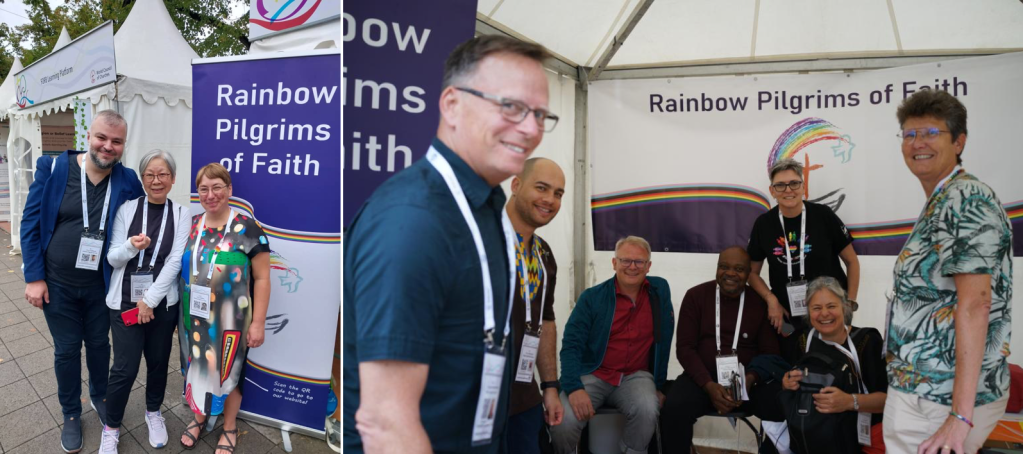
The Assembly afforded many opportunities for expanding conversations on LGBTIQ+ rights and inclusion. Countless informal conversations unfolded around the Rainbow Pilgrims of Faith booth, along with the panels at Canisiushaus – the Encounter Centre for Women, Men, Family, Gender and Diversity – and inside the Assembly site at the Swiss Hub, in a RGHS workshop and in four sessions among delegates and advisors of Ecumenical Conversation No. 11 that dealt with work on human sexuality.
Among the Rainbow Pilgrims was Small Luk, a Christian Intersex activist from Hong Kong. “It was so great Intersex people had a chance join the WCC Assembly and to work with the Rainbow Pilgrims of Faith,” she said later. She said she was pleased that WCC’s Conversation on the Pilgrim Way includes the concerns for Intersex people.
“I am eager that the church will have concern for Intersex human rights and stand with the parents having the Intersex children,” she said. “And stop saying that ‘Intersex children are the result from sin.’ May God’s love for Intersex people and their families be held with God’s blessings with the church.”
Some made new friends, among them staff colleagues from the National Council of Churches of India (NCCI): Fr. Thomas Ninan and Rev. Deva Jothikumar. For more than 20 years, NCCI has been working among its members to build understanding for and alliances with LGBTIQ+ people. (You can see short interviews with each of them by clicking on their names above.)
Other Rainbow Pilgrims said the Assembly provided space for conversations with church leaders that are sometimes impossible amidst greater tension at home.
Unlike the previous WCC Assembly in Busan, South Korea, in 2013, the presence of Rainbow Pilgrims in Karlsruhe seemed to provoke little controversy. Media coverage was generally positive. A few examples:
- A reflection by Lee Catoe of the Presbyterian Church (USA) for a publication he edits, Unbound
- Presbyterian News Service: LGBTQIA+ Christians celebrate diversity at World Council of Churches Assembly
- Italian Evangelical News: Attivisti LGBTQIA+ al Consiglio ecumenico: rispetto, diritti e libertà

 Rainbow Pilgrims of Faith